


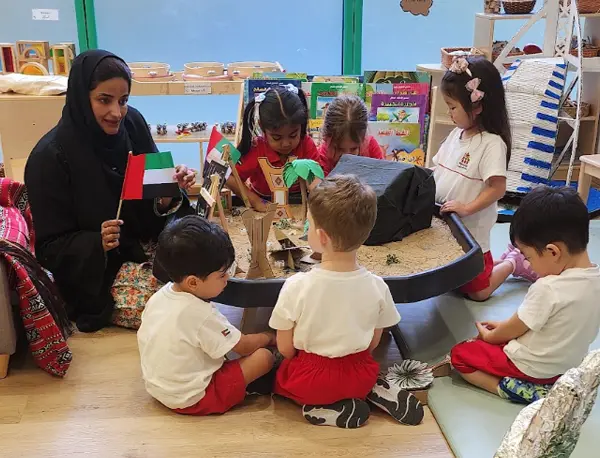
Walk into an early years classroom built on an inquiry-based approach, and the first thing you’ll notice is the noise — not chaos, but the productive hum of children asking questions, testing ideas, and explaining their thinking to one another.
For parents evaluating early years programs, “inquiry-based” is a term that comes up often but is rarely explained clearly. This article breaks down what the approach actually means in practice, why educators favour it, and how it shows up day-to-day in a quality early years setting.
Defining the Inquiry-Based Approach
An inquiry-based approach is a way of teaching that starts from a child’s own questions and natural curiosity, rather than from a fixed script of facts to be delivered. Instead of being told an answer, a child is guided to investigate, test, and discover it with a teacher facilitating rather than dictating.
In early years settings, this typically unfolds through structured inquiry (the teacher poses the question and outlines the method), guided inquiry (the teacher poses the question but children choose how to investigate), and open inquiry (children generate their own questions and investigation methods). Each has its place depending on a child’s age, confidence, and prior experience with this style of learning.
Educators favour this progression because it builds independence gradually. A three-year-old exploring “which objects float?” needs more scaffolding than a five-year-old designing their own experiment to test it.
Many early childhood frameworks now describe inquiry as a cycle; children pose questions, investigate, interpret what they find, and share their conclusions and teachers intentionally move children through this cycle again and again so that the habits of inquiry become part of how they think, not just how they complete a single activity.
Why It Matters for Young Children
The case for an inquiry-based approach in the early years rests on how children’s brains actually develop understanding. Inquiry-based learning offers a wealth of benefits for early childhood education, from developing critical thinking and problem-solving skills to promoting collaboration and deeper understanding, and the effect compounds across subject areas rather than staying confined to one.
Research summarised in early childhood pedagogy literature points to concrete developmental gains. Inquiry-based learning nurtures children’s natural curiosity and supports the development of critical thinking, problem-solving, and social skills.
The mechanism behind this is worth understanding. When children build, test, and revise their own ideas, they are doing more than completing an activity. Hands-on exploration strengthens retention by engaging multiple sensory modalities and creating embodied experiences that anchor abstract concepts in memory. A concept a child discovers through their own investigation tends to stick in a way that a concept simply told to them does not.
Academic literature also links this approach to school readiness. A summary of research on early STEM and maths learning found that effective, inquiry-rich instruction in the early years can enhance later learning and narrow achievement gaps, reinforcing why the foundational years matter so much for long-term academic outcomes.
What Inquiry-Based Learning Looks Like in a Real Classroom
Theory aside, here is what the approach tends to look like on any given day:
- A question sparks the session. A child notices ice melting on the windowsill and asks why. Instead of an immediate answer, the teacher asks: “What do you think is happening? How could we find out?”
- Investigation follows. Children might place ice in different spots around the room, predict outcomes, and observe what actually happens.
- Reflection consolidates learning. The group discusses what they noticed, compares predictions to results, and the teacher introduces the vocabulary that gives language to what they’ve just experienced.
- Documentation makes thinking visible. Drawings, photos, and simple charts capture the process, so children can revisit how understanding developed over time.
This cycle repeats across subjects, whether the topic is science, numeracy, or even social problem-solving during play. Inquiry-based project work in early childhood has been shown to increase children’s engagement and collaborative skills because they see themselves as active participants in the investigation rather than passive recipients of information.
How This Connects to Academic Excellence
An inquiry-based approach is sometimes mistaken for an unstructured or purely play-driven method. In practice, it is the opposite: it is a highly deliberate pedagogical structure designed to build the reasoning skills that underpin later academic success. Teachers plan investigations around specific learning objectives, scaffold vocabulary carefully, and track each child’s developing competencies against curriculum milestones.
Studies of early STEM inquiry lessons show that when teachers frame activities around meaningful questions, invite children’s predictions, and revisit their findings, children demonstrate deeper understanding and greater ability to explain their thinking.
The Role of Family and Community
Inquiry doesn’t stop at the classroom door. Parents play a meaningful role in extending this approach at home — asking open-ended questions during everyday moments, resisting the urge to give an immediate answer, and showing genuine curiosity alongside their child. Schools that take this approach seriously often share documentation of classroom inquiries with families, creating a shared language between home and school and strengthening the sense of community around a child’s learning journey.
Beyond the Classroom
The habits built through inquiry extend well beyond any single subject. These are the same habits that support resilience, adaptability, and independent thinking later in life. An early years programme grounded in inquiry is, in effect, investing in dispositions that outlast any particular curriculum topic.
In a world where information is everywhere, the ability to frame a thoughtful question, evaluate evidence, and revise one’s understanding is arguably more important than memorising any fixed set of facts. That is precisely what an inquiry-based classroom is practising, at a developmentally appropriate level, every day.
Conclusion
An inquiry-based approach reframes the early years classroom from a place where facts are delivered to a place where understanding is built. For families weighing early years options, it’s worth asking any prospective school how they structure inquiry, how they document a child’s thinking over time, and how classroom inquiry connects with family life at home because a genuinely inquiry-driven programme should be visible in all three places.
Frequently Asked Questions
Q1. Is an inquiry-based approach suitable for very young children?
Yes. The method is adapted by age, younger children work through heavily guided, teacher-supported inquiries, while older early years children take on more open-ended investigation as their confidence grows.
Q2. Does inquiry-based learning still cover core academic content?
Yes. Teachers plan inquiries deliberately around curriculum objectives in literacy, numeracy, and science; the approach changes how content is taught, not whether it is taught.
Q3. How is this different from unstructured free play?
Free play is child-directed with minimal adult framing. An inquiry-based approach is intentionally structured by the teacher around a learning goal, even when it appears open-ended to a child.


